
Rise Institute

November 2022

How to become a etl developer

How To Become A ETL Developer

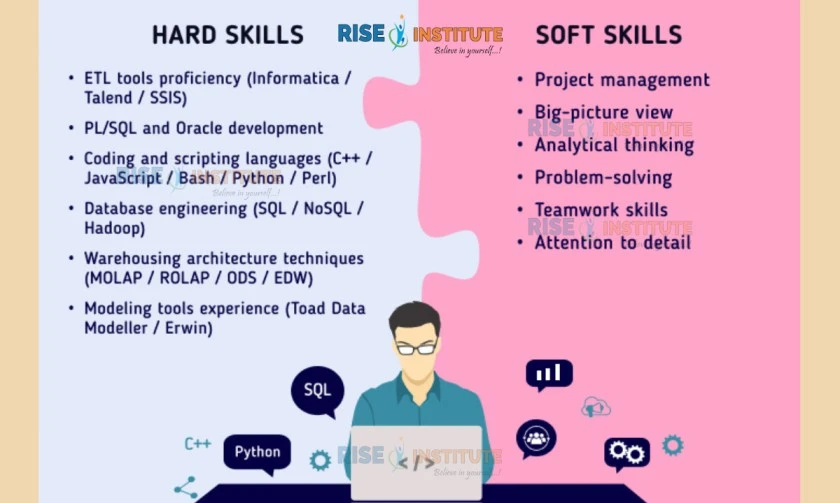
How to become a ETL developer? While the job market is growing rapidly, it’s not as easy as just sending in your resume. In order to become an ETL developer, you need to have the right skills.But don’t worry, we’re here to help. In this post, we’ll outline the skills that you need to become and ETL developer and what you can do to acquire them. We’ll also include a few resources to help get you started. What Is an ETL Developer? An ETL developer is responsible for the Extract, Transform, and Load (ETL) process. This process is used to collect data from various sources, clean and normalize it, and then load it into a target database.In order to be an successful ETL developer, you need to have a strong understanding of data warehousing concepts, as well as experience with a variety of ETL tools. You also need to be able to write SQL queries, as this is often used in the ETL process. If you’re interested in becoming an  developer, I suggest taking some courses on data warehousing and ETL tools. You can also find some helpful resources online. And of course, practice makes perfect, so be sure to get some hands-on experience with ETL before you apply for jobs. What Skills Does an ETL Developer Need? You’ll need a few specific skills to become an good ETL dev. First, you’ll need to know how to extract data from various data sources. This might include databases, text files, and web services.Next, you’ll need to know how to transform this data. This includes cleansing the data, normalizing it, and converting it into a format that can be used by the target system. Finally, you’ll need to know how to load the transformed data into the target system. This might be a relational database, a data warehouse, or another type of system. In addition to these technical skills, you’ll also need strong communication and problem-solving skills. ETL developers need to be able to work with business users to understand their needs and then translate those needs into technical requirements. They also need to be able to troubleshoot issues that arise during the ETL process. How to Become an ETL Developer In order to become an good ETL developer, you will need a few key skills. First and foremost, you should have a strong background in Structured Query Language (SQL). SQL is a programming language used for managing data in databases. In order to be successful in this role, you should be able to write SQL queries to extract data from databases, as well as load data into databases. In addition to having a strong SQL background, it is also important to have experience with ETL tools such as Informatica PowerCenter, Oracle Data Integrator (ODI), or Talend. These tools are used to automate the process of extracting, transforming, and loading data. Familiarity with these tools will be essential in this role. Finally, it is also important to have strong problem-solving skills. As an developer, you will be responsible for troubleshooting issues that arise during the ETL process. Being able to identify and solve problems quickly and efficiently is a key skill in this role. The Role of an ETL Developer in a Company In a nutshell, an ETL developer is responsible for extracting data from various sources, transforming it into a format that can be used by the company, and then loading it into the system. However, that’s just the basics. An developer also needs to be able to understand the company’s data needs and design ETL processes that meet those needs. They also need to be able to troubleshoot issues that arise during the ETL process and work with other team members to resolve those issues. And finally, an good ETL developer needs to have strong communication skills. They need to be able to communicate with team members from various departments in order to get a clear understanding of the company’s data needs. They also need to be able to communicate their designs and solutions clearly so that everyone is on the same page. The Different Types of Etl Tools Available When it comes to ETL tools, there are a few different types you can choose from. The most common ones are commercial tools, open-source tools, and custom-built tools. Commercial tools are the ones that you have to pay for. They’re usually pretty user-friendly and come with a lot of features and support. Open source tools are free to use, but they might not be as user-friendly and might not come with as much support. Custom-built tools are just that’s tools that are built specifically for your needs. So, which one should you choose? It really depends on your needs and what you’re looking for. If you need something that’s user-friendly and comes with a lot of features, then a commercial tool might be the way to go. If you’re on a budget or if you need something specific, then an open source or custom-built tool might be a better choice. How much money do They make? The average salary is $7,000-$15,000 per year. What kind of training or education is required? There is no one-size-fits-all answer when it comes to training or education, as it depends on the specific organization’s needs. However, some common requirements include a bachelor’s degree in computer science or a related field, as well as experience in database administration or programming. What are some common challenges faced by ETL developers? Some common challenges faced by developers include data quality issues, performance bottlenecks, and implementation difficulties. Conclusion If you have coding skills and an interest in business intelligence, a career as an ETL developer could be a great fit for you. There’s a lot to learn, but with the right skill set, you can become an expert in the field. The most important thing for an good developer is to have strong coding skills. If you’re not a coder, you’ll need to learn the basics before you

How To Become A ETL Developer Read More »

sql for beginners

SQL for Beginners

In the world of data science sql for beginners, SQL is the king of languages.SQL is a powerful query language that lets you manipulate and analyze data in a variety of ways. With SQL, you can easily find out what’s in your data set, make calculations, and get insights that would be difficult or impossible to extract using other methods.In this article, we’ll take a look at the basics of SQL syntax and how to use it to get the most out of your data. What Is SQL? SQL is a domain-specific language used in programming and designed for managing data held in a relational database management system, or for stream processing in a relational data stream management system.SQL is widely used by many different database vendors, including MySQL, Oracle, Microsoft SQL Server, PostgreSQL, and SQLite.  In addition to being a standard database query language, it is also used in data mining, decision support, and creating artificial intelligence applications.So what does SQL stand for? The “S” stands for “structured,” the “Q” stands for “query,” and the “L” stands for “language.” Is SQL a coding languages? You might be wondering, is SQL a coding language? The answer is a little bit complicated.SQL is what’s known as a declarative programming language, which means that it’s designed to describe what data should be, rather than how to get there. In contrast, coding languages like Python are known as imperative programming languages, which means that they focus on how to get the desired result. So if you’re wondering whether SQL is a coding language, the answer is both yes and no. It really depends on your definition of “coding language.” Is SQL a Python language? No, SQL is not a Python language. SQL is a query language, which is used to communicate with databases. Python is a programming language. What are the 5 basic SQL commands? Just like any language, SQL has a set of commands that you can use to manipulate data. These commands are typically divided into four categories: data retrieval, data manipulation, data definition, and data control.The five basic SQL commands are: SELECT: Used to retrieve data from a databaseINSERT: Used to insert new data into a databaseUPDATE: Used to update existing data in a databaseDELETE: Used to delete data from a databaseCREATE: Used to create new databases and tables Which is harder SQL or Python? That’s a tough question. They’re both pretty tough languages to learn, but I think Python might be a bit harder because it’s not as specialized as SQL.With SQL, you’re mostly dealing with retrieving data from databases, so the syntax is pretty straightforward. With Python, you can do that too, but you can also do things like web development, data analysis, artificial intelligence, and more. So I guess it depends on what you want to use the language for. If you just want to learn SQL to work with databases, then it might not be as hard as Python. But if you want to learn Python to do things like data science or web development, then it might be a bit tougher. Conclusion SQL is the standard language for dealing with databases, and it’s an essential tool for anyone working in data science. If you’re not already familiar with SQL, now is the time to learn. It’s not as difficult as it might seem, and you’ll be glad you have the skills when you need them. Click here to learn more

SQL for Beginners Read More »

python

How to Become a Python Expert

You’ve decided you want to become a Python expert. This is an exciting decision that will open up a world of opportunities for you.we’ll walk you through everything you need to know to become a Python expert. We’ll start with the basics and work our way up to more advanced concepts. You’ll learn everything from the history of Python to how to write your first program. What Is Python? So, you want to become a Python expert? Great! Python is a versatile language that you can use on the backend, front end, or full stack of a web application. You can also use it for data science, machine learning, artificial intelligence, and more.Python is an interpreted, high-level, general-purpose programming language with dynamic semantics. Its simple syntax and readability make it a great language for beginners to learn. Python is also object-oriented, which means it’s easy to modularize code and create reusable components. What Are the Benefits of Learning Python? There are plenty of benefits of learning Python. For one, it is a versatile language that can be used for everything from web development to scientific computing. It is also easy to learn for beginners and has a large and active community that can help you with anything you need.Python is also a great language for data analytics and machine learning. If you want to get into these cutting-edge fields, learning Python is a great place to start. It is also a great language for automating tasks or building small scripts to make your life easier.In short, learning Python can make you more efficient, productive, and valuable in the workplace. It is definitely worth your time and effort to learn this powerful language. What Are the Different Types of Python? There are three main types of Python:Python 2: This was the first version of the language and is no longer supported.Python 3: This is the most up-to-date version of the language and is what we’ll be using in this guide.Anaconda: This is a distribution of Python that comes with a lot of additional features and libraries. It’s not necessary to use Anaconda, but it can make your life a lot easier, especially if you’re new to Python.Now that we’ve covered the basics, let’s move on to some more advanced topics. Which Python Should I Learn First? You might be wondering, with all these different types of Python, which one should you learn first?The answer really depends on what you want to use Python for. If you’re interested in doing data science or scientific computing, then you might want to start with Anaconda. If you’re interested in web development, then you might want to start with Django. But if you’re just starting out and want to get a feel for the language, then I recommend starting with Python 3. It’s the most current version of the language and will be the one that most libraries and frameworks are developed for. Where Can I Learn Python? Fortunately, there are plenty of resources out there that can help you learn Python. Here are a few of my favourites:– Rise Institute offers a comprehensive, interactive course that covers all the basics of Python programming.– Treehouse has an excellent course on Python that covers everything from the basics to more advanced concepts.– Udemy also offers a variety of courses on Python, both for beginners and more advanced learners.Of course, there are also plenty of books and other resources that can help you learn Python. But in my opinion, the best way to learn is by doing, so I recommend finding a course or tutorial that you can work through at your own pace. How Long Does It Take to Become a Python Expert? The answer to this question depends on a few factors, such as your current skill level, how much time you’re willing to devote to learning Python, and what you want to use it for.If you’re starting from scratch, it might take anywhere from six months to a year to become proficient in Python. But if you already have experience with another programming language, you can probably pick it up in a matter of weeks.And if you’re only looking to use Python for simple tasks like data analysis or automating repetitive tasks, you can probably get by with just a few hours of learning.But if your goal is to become a Python expert, that’s going to take dedication and a lot of hard work. There’s no one-size-fits-all answer to this question, but the important thing is to just get started and keep learning. Conclusion You now know how to become a Python expert! Just remember to keep practicing, expanding your horizons, and refusing to give up. You can do this! Click here

How to Become a Python Expert Read More »

data

How to Become a Data Analyst

You’ve decided you want to become a data analyst. Congratulations! This is a field that’s growing in popularity and for good reason. Data analysts are in high demand, and with the right skills, you can really make a difference in your organization.So where do you start? How do you become a data analyst? The process can be daunting but don’t worry, we’re here to help. In this article, we’ll walk you through everything you need to know to make your dream of becoming a data analyst a reality. What Skills Do You Need to Be a Data Analyst? You might be wondering what skills you need to be a data analyst. Well, first and foremost, you need to be good with numbers. You should be able to understand and analyze complex data sets.In addition to being good with numbers, you should also have strong critical thinking and problem-solving skills. You’ll need to be able to identify patterns and trends in data sets and come up with solutions to problems.It’s also important that you have strong communication skills. You’ll need to be able to explain your findings to non-technical staff and clients. And you should be able to present complex information in a clear and concise manner.Last but not least, you’ll need strong computer skills. You’ll need to be proficient in Excel and other data analysis software programs. How to Get Started in Data Analytics You’re in the right place to learn how to become a data analyst! This guide will show you everything you need to know, from what skills you need to have, to what kind of jobs you can get with your new data analytics knowledge.First things first: what is data analytics? Data analytics is the process of examining data sets in order to draw conclusions about the information they contain. Data analysts use a variety of tools and techniques to clean, organize, and interpret data, and then use their findings to make recommendations about how businesses can improve their operations.Sounds interesting, right? If you’re excited about the idea of working with data and helping businesses make better decisions, then read on to learn how you can get started in data analytics! Online Resources for Learning Data Analytics Not sure where to start? Check out some of these online resources:– Harvard’s Data Science Course: https://www.edx.org/learn/data-analysis– Codecademy’s Learn SQL Course: https://www.codecademy.com/learn/learn-sql– Coursera’s Data Analysis and Interpretation Specialization: https://www.coursera.org/specializations/data-analysisThese are just a few popular courses that will help get you started on your data analytics journey. But of course, there are many other options out there depending on your learning style and what you’re looking for in a course. Data Analyst Tools and Software The tools and software you use as a data analyst will depend on the specific role you’re in, but there are a few that are pretty universal.First, you’ll need a good spreadsheet program like Microsoft Excel or Google Sheets. You’ll also need a data visualization tool like Tableau, which will help you communicate your findings to non-technical people.If you’re working with big data, you’ll need a database management system like MySQL or MongoDB. And finally, you’ll need a coding language like Python or R to help you clean and analyze your data.Don’t worry if you’re not familiar with all of these tools and software you can learn them on the job or through online courses. But it’s important to have at least a basic understanding of them before you start your career as a data analyst. Data Analyst Certifications There are a ton of data analyst certifications out there and it can be tough to know which one is right for you. I’ve compiled a list of the most popular data analyst certifications to help you out.– Google Analytics Certified Associate: This certification is designed for individuals who want to show that they can collect and analyze data in order to help businesses make better decisions.– IBM Certified Data Analyst: This certification is designed for individuals who want to work with IBM’s products and solutions in order to help organizations make better decisions.– SAS Certified Base Programmer for SAS 9: This certification is designed for individuals who want to show that they can create, test, and deploy SAS programs.– Microsoft Certified Solutions Expert: Data Analytics: This certification is designed for individuals who want to show that they can use data analytics to solve business problems. Conclusion Now that you know how to become a data analyst, it’s time to take the next steps and start your journey. Data analytics is a growing field, and there’s never been a better time to get started.If you’re not sure where to start, try taking a course or two on data analytics. There are plenty of online options to choose from, and you can always find free resources if you’re on a tight budget. Once you’ve got the basics down, start looking for entry-level jobs in the field.Don’t be afraid to network, either. Connecting with other professionals in the field is a great way to learn more about data analytics and find opportunities.So what are you waiting for? Get started today and see where a career in data analytics can take you.

How to Become a Data Analyst Read More »

Google’s Search Central: Guide to Market Your Business Online

Introduction Google is the world’s most popular search engine, and it can be a powerful tool for marketing your business online.In this guide, we will show you how to use Google Search to reach potential customers and grow your business. We will cover everything from setting up a Google Ads campaign to optimizing your website for Google Search.So, whether you are just starting out or you are looking for ways to improve your current marketing strategy, this guide is for you. Let’s get started! What Is Google Search Central? Google Search Central is a powerful tool for marketing your business online.With Search Central, you can control how your business appears in Google search results. You can also create and manage ads that appear next to your listings.Search Central is a powerful tool that can help you reach new customers and grow your business. What Are the Benefits of Using Search Central? There are many benefits to using Search Central to market your business online.First, it is a cost-effective way to reach potential customers. You can create a campaign and set a budget that fits your needs and goals.Second, it is an easy way to track results. You can see how many people have seen your ads and how many of them have clicked on them. This helps you to gage the effectiveness of your marketing efforts and make necessary adjustments.Third, it gives you the ability to target specific audiences. You can choose who sees your ads based on factors such as location, age, gender, interests, and more. This ensures that your marketing dollars are spent on reaching the people who are most likely to be interested in your products or services.Fourth, it allows you to customize your message. You can create different ads for different audiences and test different messages to see what works best.Finally, it provides a valuable source of data. You can use the information you collect from Search Central to improve your overall marketing strategy. How Do I Get Started With Search Central? To get started with Search Central, the first thing you need to do is create a Google My Business listing. This is a free listing that will appear in search results when people look for your business.To create a listing, go to the Google My Business website and click on “Add your business.” Enter your business name, address, and phone number. You’ll also need to choose a category for your business.Once your listing is created, you can start adding photos, videos, and other content to it. You can also use Search Central to track your performance in search results and see how much traffic you’re getting from your listing. What Are Some Tips for Using Search Central Effectively? Here are some tips for using Search Central effectively:1. Use keyword-rich titles and descriptions.2. Create compelling, original content.3. Optimize your website for the search engines.4. Promote your website through social media and other online channels.5. Monitor your website’s performance in the search engines and adjust your marketing accordingly.By following these tips, you can ensure that your website appears prominently in the search results and attract more visitors to your site. How Can I Track My Results With Search Central? You can track your results in a number of ways, but the simplest is to just keep an eye on your website’s traffic. If you see a spike in traffic after making changes to your website or creating new content, that’s a good sign that Search Central is working for you.Another way to track your results is to use Google Analytics. This tool can help you see how people are finding your website and what they’re doing once they’re there. Google Analytics is a bit more technical than simply monitoring your website’s traffic, but it’s worth taking the time to learn if you want to get the most out of Search Central. FAQs About Using Google Search Central FAQs About Using Google Search Central Q: What is Google Search Central? A: Google Search Central is a free online marketing platform that helps businesses promote their products and services to potential customers. Q: How does it work? A: businesses create listings for their products and services on Google Search Central, which are then displayed to users who are searching for related terms on Google.com. Q: What are the benefits of using Google Search Central? A: There are numerous benefits to using Google Search Central, including increased visibility for your business, the ability to reach a large audience, and improved search engine optimization (SEO). Q: Is there a downside to using Google Search Central? A: While there are many advantages to using Google Search Central, there are also some potential disadvantages. One downside is that businesses may have to pay for certain features, such as listing their business in multiple categories or adding photos and videos. Additionally, there is always the possibility that your listing could be removed from Google Search Central if you violate any of their policies. Conclusion Now that you know all about Google’s Search Central, it’s time to put it to use and start marketing your business online. With the right approach, you can use Search Central to your advantage and start driving traffic to your website.So what are you waiting for? Get started today and see the results for yourself.

Google’s Search Central: Guide to Market Your Business Online Read More »

[contact-form-7 id="d95d443" title="Rise Contact Form"]